
Salem County VINELink Coverage
New Jersey VINELink is a custody-status and notification service supplied with events from participating agencies. It is useful for checking a person who is in a reporting custody and for registering for a later event. The selected record’s agency or facility defines what the status means. Coverage should not be assumed to be identical across every county jail, municipal lockup, and state institution.
VINELink is not the county’s official historic release search. The Salem County Sheriff’s corrections page links the county IML with an “Include released inmates” switch and Release Date field. NJDOC has a separate offender record with state incarceration history and Date Out-of-Custody. VINE adds a one-person event and alert layer; the originating jail or corrections record remains the stronger confirmation.
A released VINE record establishes that the reporting agency marked that custody event ended. It does not establish that the person entered the community. Salem County can release a person to NJDOC, another county, federal authority, or immigration custody. The receiving system must be checked when a handoff is possible.
Search Salem County VINELink Records
Search one person at a time. A common name or spelling variant can return the wrong record or no record. Use the offender or booking identifier when known, and compare the reporting agency before opening the result.
- Open the official New Jersey VINELink portal and choose the offender or person search.
- Enter the last name and given name. Add the available identifier when known.
- Review all possible matches instead of selecting the first similar name.
- Compare the reporting facility or agency and any displayed identity details.
- Open the correct person and read the custody status in the context of that agency.
- If no match appears, try a name variant and then check the originating jail or NJDOC record.
- Use the notification option only from the verified individual record.
The Salem County released inmate search explains how to move between the IML, NJDOC, court, BOP, and ICE systems when the VINE result is missing or too narrow. A no-result can reflect a name mismatch, a nonparticipating event, a reporting delay, or an older custody episode outside VINE’s purpose.
Salem VINELink Release Fields
The live New Jersey portal should control the wording displayed for a record. The captured interface supports the custody-status and reporting-agency functions, while other fields can vary with the participating agency. Do not invent a scheduled date or identifier that is not visible on the selected result.
| VINE element | What it establishes | What it does not establish |
|---|---|---|
| Person match | The selected record identity within available fields | Identity across every other system |
| Reporting agency or facility | The authority supplying the event | Every later receiving authority |
| Custody status | The status reported for that episode | A complete custody history |
| Released or out of custody | The reporting custody event ended | Freedom from all holds or supervision |
| Get Notified | An alert can be requested for offered events | A guarantee of instant delivery |
The official New Jersey VINELink portal is shown below. The screenshot identifies the state-specific person search used before a record or notification is selected.
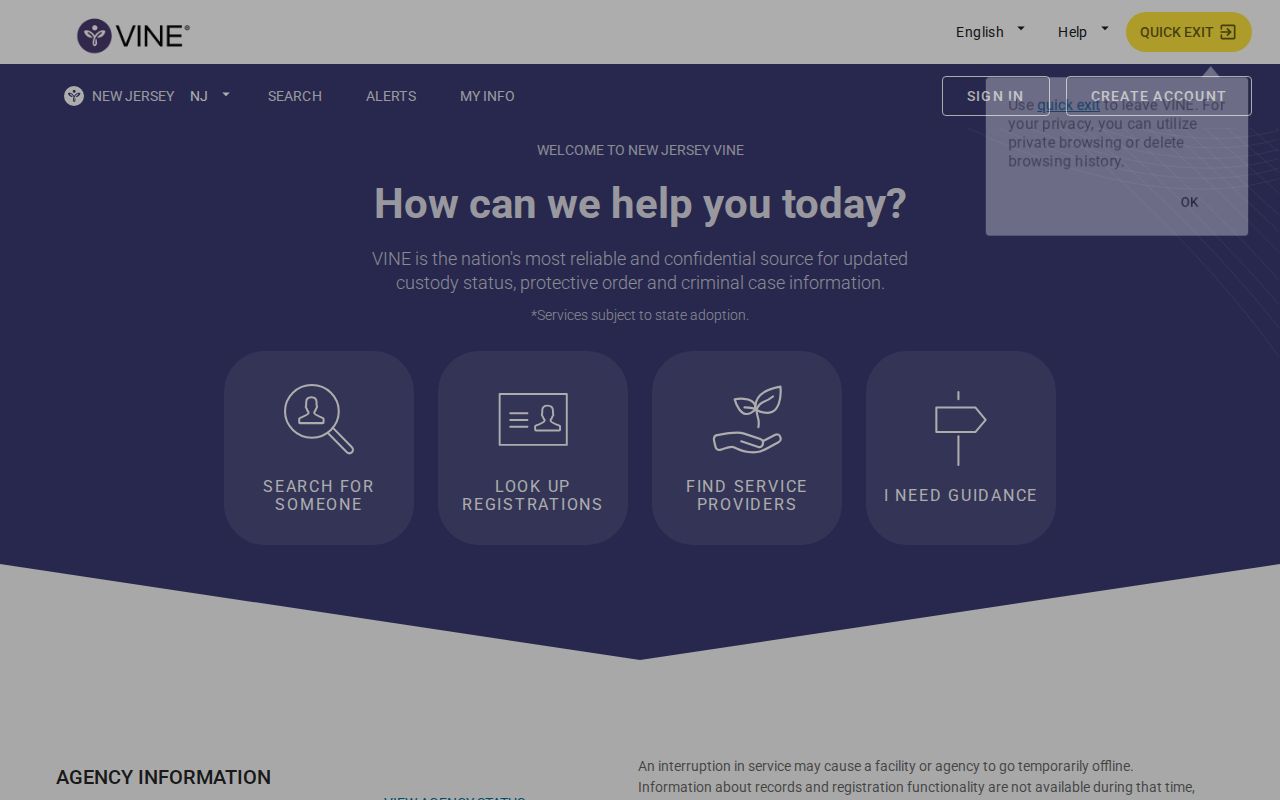
The image shows the correct portal entry. The actual record must still be matched to Salem County Correctional Facility, NJDOC, or the participating agency that supplied it.
Register Salem County Release Alerts
Registration starts from the correct individual record. Available events and delivery channels can depend on the reporting agency. Enter only a contact destination that you are authorized to use, and keep confirmation details private.
- Select the matched person and choose “Get Notified” or “Register for Notifications.”
- Select a release or custody-change event offered for that record.
- Choose telephone, text, or email from the available channels.
- Enter the destination and confirm it carefully.
- For a phone alert, create a private four-digit PIN.
- When VINE calls, enter the PIN to confirm receipt and stop repeated calls.
- Complete the separate link or code verification shown for text or email.
Save the confirmation privately. Never publish the PIN or place it in a records request. Update or cancel the registration through VINELink when the alert is no longer needed. A notification is a prompt to verify the event with the responsible agency, not a replacement for the release record.
Read Salem VINELink Release Status
“Released” must be read with the reporting agency attached. If SCCF reports the event, the Salem County booking ended. A transfer to NJDOC can follow. If NJDOC reports the event, state custody ended, but parole, federal supervised release, or another authority may still matter. The word is not a universal declaration that all legal custody or supervision ended.
For the county episode, search the Salem IML with “Include released inmates” selected. Match the name, DOB, Booking Number, or Permanent ID and read Release Date. If the circumstances suggest a state sentence, search NJDOC for Date In-Custody, Date Out-of-Custody, current facility, and incarceration history. The county and state dates can mark consecutive episodes.
Court dispositions answer a different question. A dismissal, sentence, or release order supplies legal authority but may not record the moment SCCF processed the exit. Pair the court order with the agency record. When another warrant or detainer exists, request the recorded receiving authority.
Verify Salem Release Alerts Locally
Salem’s official IML is the strongest online county fallback because it expressly includes released people. Search by first and last name with optional DOB, or use Booking Number, Permanent Number, State ID, County ID, FBI Number, or ICE Number. Results show name, Booking Number, Permanent ID, DOB, and Release Date.
The county interface states no update cadence or public archive period. For a just-processed release, use the Sheriff’s contact page and call Salem County Correctional Facility at 856-769-4300. For durable detail, use the Salem County OPRA route and request the existing release or discharge entry, recorded date and time, release type or code, and receiving authority.
NJDOC uses its own retrospective field. Date Out-of-Custody records the end of a state custody episode. Current Max Release Date is a changing calculation, and Current Parole Eligibility Date is an eligibility point. Neither future field confirms that a VINE alert should already have occurred.
Note: A missing VINE result does not prove release, transfer, or absence from custody; verify through the agency that last held the person.
Match Salem VINELink Identities
A custody alert is useful only when it follows the intended person. Names can be shared, reversed, hyphenated, abbreviated, or entered with an alias. A DOB and agency-specific identifier provide a stronger match. Salem’s county search supports six identifier choices, while NJDOC, BOP, and ICE each use different numbers. Do not move an identifier from one system into another unless that search expressly accepts it.
For SCCF, retain the Booking Number and Permanent ID from the county result. For NJDOC, compare the SBI or inmate number, aliases, county of commitment, and incarceration history. BOP uses a federal register number and also accepts other listed federal identifiers. ICE’s strongest route uses an A-number with country of birth. The reporting facility should also fit the known custody path.
If two people remain possible, stop before registering. Open the official source record, compare identity details, and contact the agency when the public fields do not resolve the ambiguity. An alert tied to the wrong person can create a false impression of release or transfer. VINE’s absence is similarly inconclusive when the name or agency does not match.
After a Salem VINELink Alert
Record the date, reported event, and reporting agency when a notification arrives. Then verify through the source that owns that custody. For SCCF, check the IML released option and call the jail if the event is recent. For NJDOC, reopen the offender search and inspect the current facility, incarceration history, and Date Out-of-Custody. A court order can explain the legal reason, while the agency record confirms processing.
A transfer alert requires the receiving system. NJDOC may show a person who left Salem County for state custody. Another county jail may hold someone on its warrant. Federal and immigration handoffs require BOP, the federal docket or holding facility, or ICE ODLS as the facts dictate. Do not assume the alert itself names every later authority.
If the alert seems late, incorrect, or incomplete, report the problem through VINELink and the responsible agency. Save private confirmation information, but do not share the phone PIN. For a durable correction, request the agency’s release entry and any amendment history. The county OPRA description should identify the person, booking, facility, date range, and exact existing record sought.
Salem VINELink Coverage Limits
VINELink is not the federal Bureau of Prisons locator. Use the BOP Inmate Locator for a federal prison record. BOP results include a release date and location; a past date with no facility means the person left BOP custody on that date. “IN TRANSIT” still means custody, and a future federal date can change.
USMS pretrial and transport custody has no comparable public locator. The District of New Jersey docket, holding facility, or USMS may be needed before BOP designation. ICE uses its own Online Detainee Locator System, searched by A-number plus country of birth or by biographical details. A county release to ICE is a custodial handoff.
VINE data can lag, and a temporary or transfer event may be narrower than expected. The service is not a permanent archive. For past proof, use the Salem release entry, NJDOC Date Out-of-Custody, BOP past Release Date, or the correct court and agency record.
Alerts are valuable when the person and reporting agency are correctly matched. Final verification still comes from the facility, corrections department, court, or receiving authority that created the event.