
Salem Projected Versus Actual Release
A projected date is a calculation made before custody ends. An actual release date is recorded after an agency processes the exit. New Jersey uses specific labels that should not be collapsed into one generic “release date.” NJDOC’s Current Max Release Date is a changing sentence ceiling. Current Parole Eligibility Date marks an expected eligibility point. Date Out-of-Custody is retrospective evidence that a state custody episode ended.
A pretrial person at Salem County Correctional Facility generally has no calculated sentence endpoint. Bond, a release order, dismissal, plea, sentencing, or another hold can control when and where the person goes. Even a court release order may not produce immediate community release if a detainer requires a handoff. The county IML displays Release Date only after the county entry exists. It does not publish a projected county release field.
A sentenced person can still have more than one relevant date. The maximum sentence calculation, parole eligibility, a possible Board decision, and the jail’s physical processing are distinct stages. Always name the field and agency when sharing a date.
Find Salem County Projected Dates
Begin with the authority that holds the person. A Salem County prosecution can lead to NJDOC confinement anywhere in New Jersey. “County of Commitment: Salem” identifies the court venue, not a prison location. A person serving only a county sentence remains on the county and court path.
- Confirm identity with the name, DOB, booking number, SBI number, or other official identifier.
- For NJDOC custody, enter through the official Offender Information page and accept its notice.
- Compare aliases, county of commitment, admission history, and identifiers before selecting a record.
- Read Current Max Release Date, Current Parole Eligibility Date, and Date Out-of-Custody under their separate official definitions.
- For a county sentence, obtain the judgment, commitment, awarded jail credits, and release calculation from the court or SCCF record.
- For a pretrial case, review the court order and contact SCCF. Do not manufacture a date from a hearing schedule.
- After release, use the county Release Date or NJDOC Date Out-of-Custody as retrospective confirmation.
The Salem County released inmate search supplies the full county, court, state, federal, and records-request path. When the NJDOC public record is older than its display period, use the State OPRA portal rather than treating absence as proof.
New Jersey Release Date Credits
NJDOC calculations can reflect several kinds of credit. They do not all work the same way, and none should be applied as a simple percentage to every sentence. R.S. 30:4-140 provides progressive commutation credits for continuous orderly conduct, subject to forfeiture for flagrant misconduct. NJDOC’s family guide explains that the schedule depends on the sentence and custody record.
Work credit is authorized separately. NJDOC describes one day deducted for each five days in a qualifying work, vocational, or mandatory education assignment. Minimum-custody credit is three credits per month during the first twelve months in minimum custody and five per month afterward. Court-awarded jail or presentence credits also affect the calculation under their own rules.
- Commutation credit
- Days earned under a progressive statutory schedule for orderly conduct.
- Work credit
- Credit tied to qualifying work, vocational, or required education days.
- Minimum-custody credit
- Monthly credit tied to qualifying minimum-custody placement.
- Court credit
- Credit awarded by a judge for eligible jail or presentence time.
- Mandatory minimum
- A sentence floor that ordinary credits cannot cross.
Verified county-jail presentence work may receive work-credit treatment under applicable NJDOC rules. Ordinary presentence custody should not be described as earning state commutation credit. Obtain the calculation record when the exact basis matters.
Salem Release Dates Under NERA
The No Early Release Act does not mean every New Jersey prisoner serves 85 percent. N.J.S.A. 2C:43-7.2 applies an 85 percent parole-ineligibility term to the statute’s listed first- and second-degree crimes, including applicable attempts and conspiracies. Credits do not move release below that mandatory floor. For the statute’s calculation, a life term is treated as 75 years.
NERA also provides a supervision term as the law directs, including five years for a covered first-degree offense and three years for a covered second-degree offense. That post-release component is another reason a custody exit should not be described as the end of every legal obligation.
Outside a controlling mandatory minimum, N.J.S.A. 30:4-123.51 generally sets primary parole eligibility at one-third of the sentence, subject to detailed exceptions and calculations. Murder, NERA offenses, and other mandatory-minimum structures prevent a one-third promise. Eligibility can lead to consideration or another statutory process. It is not a release order.
Salem County Jail Release Calculations
The Salem public lookup does not calculate a future date for a county sentence. It shows Release Date after the relevant release entry is made. For a county calculation, request the judgment or commitment, jail-credit award, release calculation, and final release entry. The court establishes the sentence and credits it awards. SCCF maintains the custody and release record.
Do not copy NJDOC’s Current Max Release Date onto a county detainee. That field belongs to state custody. Likewise, do not infer a date from the length of a sentence without the start date, court credits, other commitments, and the facility calculation. A transfer to NJDOC ends the county booking but starts or continues another custody episode.
No Salem source reviewed publishes a Friday-release rule, holiday adjustment, exact release-processing time, or weekend practice. Use the Sheriff’s contact page and call SCCF at 856-769-4300 for current logistics. For a durable calculation, submit a focused request through Salem County OPRA for the existing record. Ask for the data and entries, not a new legal analysis.
Note: Salem’s county Release Date confirms a past booking endpoint; it is not a public projected-date field or a promise of community release.
Why Salem Release Dates Change
A future date is a snapshot of the facts and credits then available. NJDOC itself warns that Current Max Release Date can differ at the end of each month. A change does not automatically mean the database is wrong. It can reflect earned days, added days, a court action, or a different release path.
| Factor | Possible effect | Record to check |
|---|---|---|
| Credits earned | May reduce a calculated maximum within legal limits | NJDOC calculation history |
| Misconduct or lost credit | May add days or remove an expected reduction | Updated calculation record |
| Court order or corrected credit | May change sentence inputs | Amended judgment or order |
| Mandatory minimum | Blocks ordinary credits below the statutory floor | Judgment and controlling statute |
| Parole action | May lead to release, denial, deferment, or a later term | Board record and later NJDOC status |
| Detainer or warrant | May change the receiving authority rather than the county exit date | Detainer notice and receiving record |
A parole eligibility notice is also prospective. New Jersey’s weekly notices show a consideration month, comment deadline, and possible release-through range. They are not exact hearing appointments or decisions. Confirm the outcome through later NJDOC status, the State Parole Board Division of Release, or a disclosable Board record.
Salem Max Release Date Changes
NJDOC calls its projected sentence ceiling “Current Max Release Date.” The exact wording matters. It is the most recently calculated maximum date after days earned off and days added because of negative institutional conduct. The agency’s official field glossary says the value may differ at the end of each month.
This monthly calculation behavior is a distinctive New Jersey feature. Saving an old date does not freeze it. Reopen the official record and read the current label. If a past and current value differ, request the underlying calculation record rather than guessing which credit changed.
Current Max Release Date is also not the earliest possible parole-related exit. Current Parole Eligibility Date belongs to a separate calculation, and Board action remains separate again. Once NJDOC custody actually ends, Date Out-of-Custody and the person’s final discharge paperwork become the stronger retrospective proof.
The official search screenshot below shows the state route used to locate these fields. Enter through the NJDOC Offender Search and match the record before reading any date.
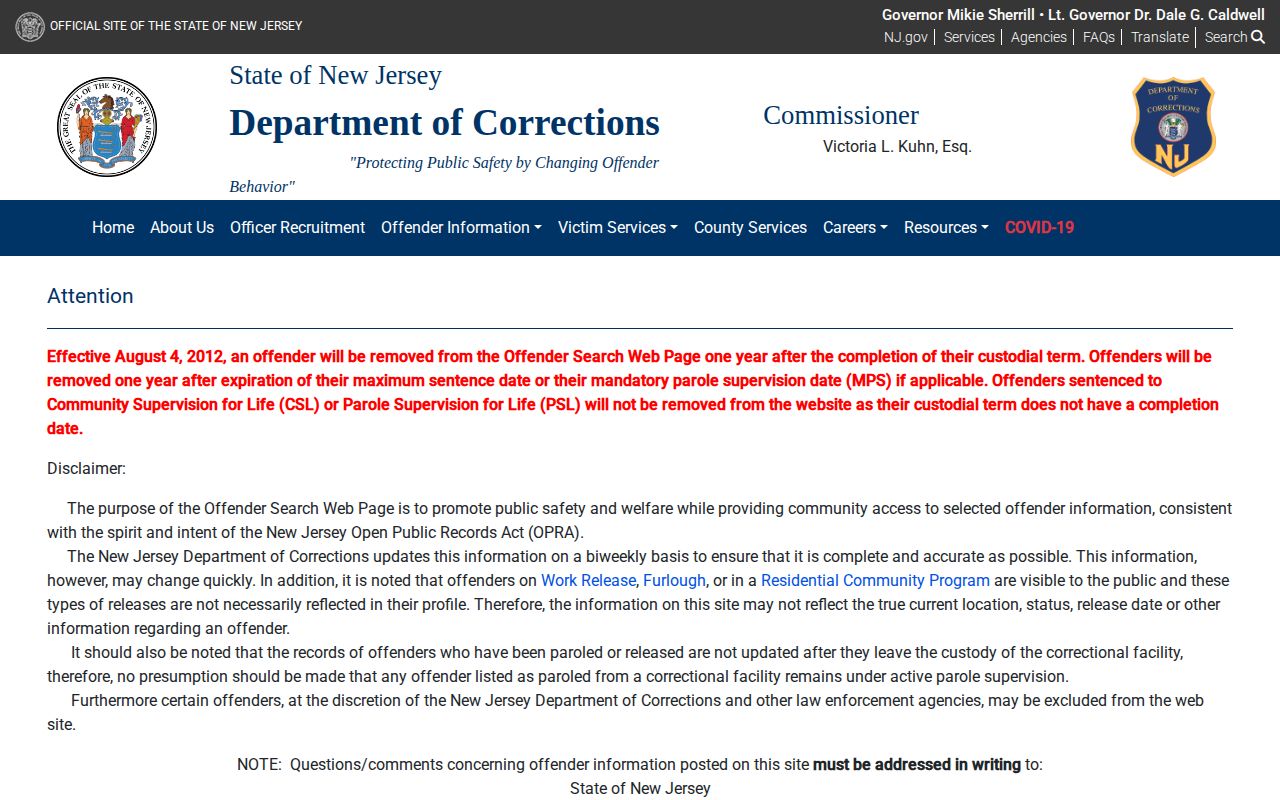
The image identifies the state system. SCCF county sentences still require the county and court calculation route.
Confirm Salem County Release Dates
Use a projected date to plan a later check, not to announce that release occurred. For NJDOC, reopen the offender record after the expected date and look for Date Out-of-Custody and incarceration history. For SCCF, search the person with “Include released inmates” selected and read the county Release Date. Call the facility when the event is recent because the IML refresh cadence is not published.
VINELink Release Check can provide an alert from a participating reporting agency. Open the correct person, verify the facility and identity, and register for the offered release or custody-change event. A VINE “released” event ends that reporting custody event. Another warrant, transfer, or hold may continue custody elsewhere.
For a lasting record, request the release or discharge entry. County OPRA can seek the release date and time, type, code, and receiving authority maintained by SCCF. The State OPRA portal can seek NJDOC incarceration history, Date Out-of-Custody, final discharge paperwork, and the calculation supporting Current Max Release Date. A court record should be requested through Judiciary channels.
Identity comes first in every system. Match DOB and the strongest official identifier, then name the field and agency. That method separates an estimate from a completed Salem County, NJDOC, federal, or immigration custody exit.
Salem Release Date Proof
Final proof depends on the custody that ended. A county release entry should identify the person, booking, facility, recorded date and time when maintained, type or code, and receiving authority if a transfer occurred. NJDOC evidence should tie Date Out-of-Custody to incarceration history and the correct state identifier. A court judgment explains the sentence or legal order but may not record the moment physical processing finished.
NJDOC’s Fair Release and Reentry Act information adds a useful personal source. A person leaving state custody receives a release portfolio that includes temporary photo identification and final discharge paperwork. It can also include a final trust-account statement or balance, a medical summary, and a warrant or detainer notice where applicable. A person seeking proof of their own state discharge should begin with that portfolio.
SCCF publishes no comparable county portfolio description. Ask the facility or OPRA custodian for the existing release calculation, entry, property receipt, and final account material that is disclosable. Do not assume a state process applies to a county booking. The requested record should state what the agency calculated and recorded, while the public lookup supplies only the narrower released-person result.